
Author : Dr. Shakuntala Sinha
Growing older brings changes in the body, family roles, and daily routine, but it does not mean life loses meaning. Using six simple but powerful ideas, a senior person can build a calm, positive, and purposeful way of living.
These ideas come from well-known speakers and thinkers—Gaur Gopal Das, BK Shivani, Maggie Kuhn, the tradition of positive thinking, the value of lifelong learning (especially with technology), and the timeless practice of doing one good deed every day.
Accept → Adapt → Learn → Connect → Contribute → Find Meaning
1. Accept That Life Includes Pain – The Wisdom of Gaur Gopal Das
Psychological purpose: Coping and acceptance
Motivational speaker Gaur Gopal Das often says, in Hindi, “ज़िन्दगी है तो तकलीफ़ होगी ही… मरने के बाद तो जलने का भी पता नहीं लगता.”
In English: “If there is life, there will be pain; after death, even the pain of being burned is not felt.”
For a senior person, this is not a pessimistic idea but a liberating one. When we accept that some discomfort, loss, and limitation are part of being human, we stop fighting reality and start responding wisely. Instead of asking, “Why is this happening to me at my age?” the question becomes, “This is part of life; what small step can I take now?”
In practice, this looks like:
Acknowledging aches, loneliness, or family tensions without exaggerating them.
Keeping a steady routine of sleep, meals, gentle movement, and social contact, because routine reduces the impact of pain.
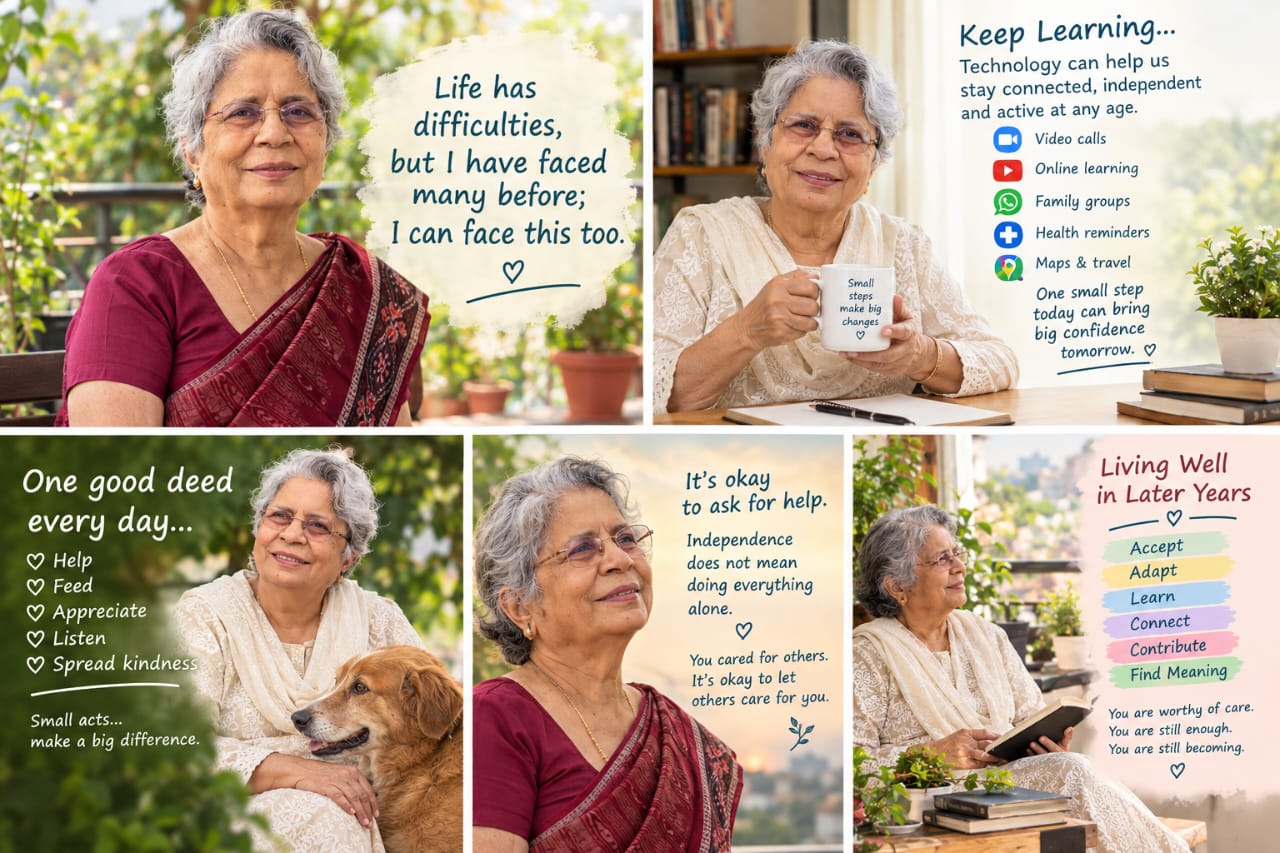
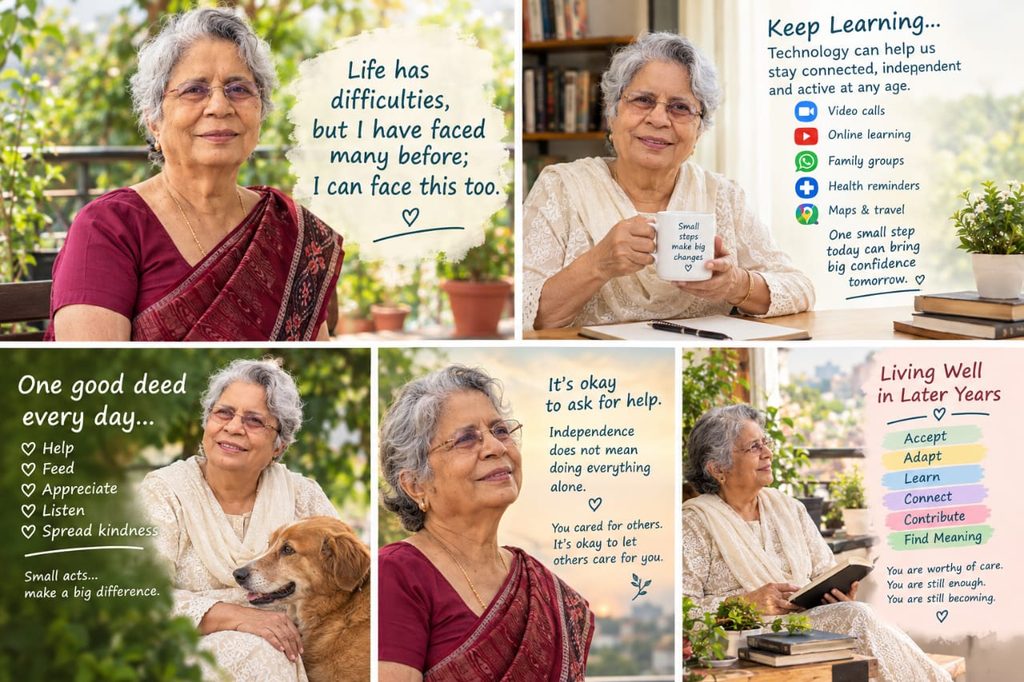
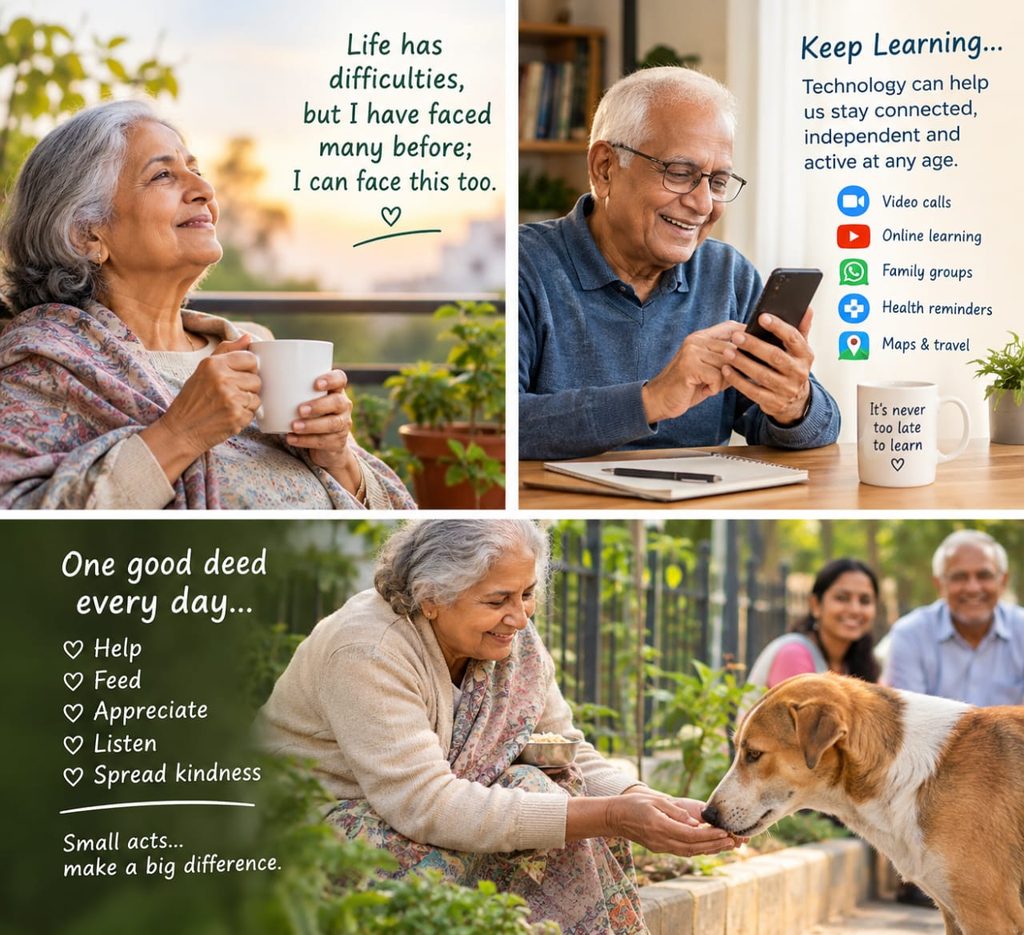
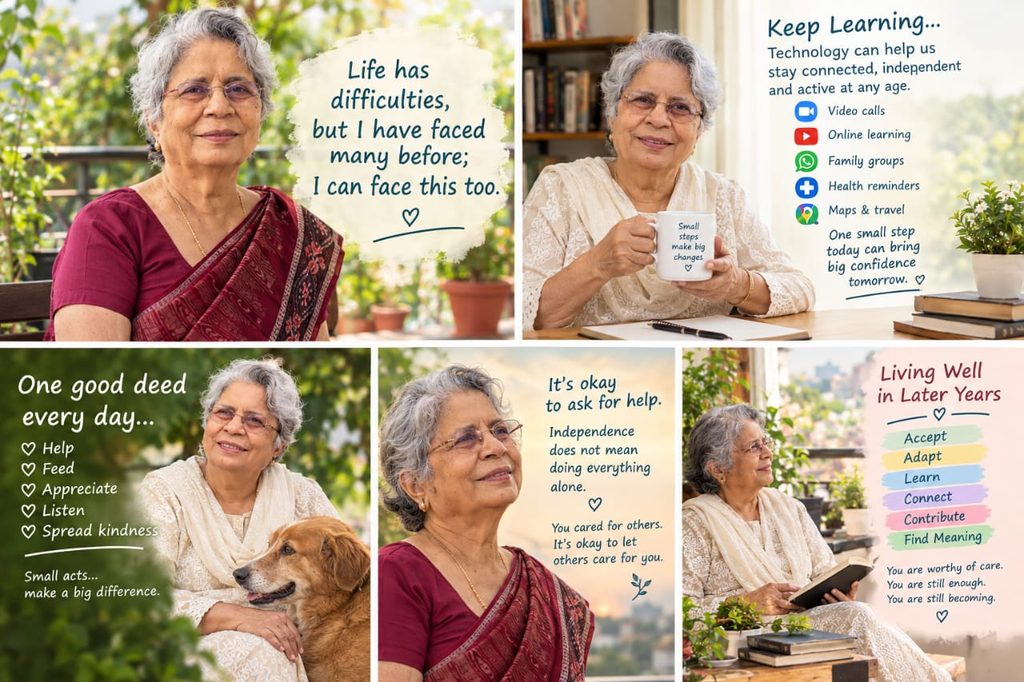
Reminding oneself: “Life has difficulties, but I have faced many before; I can face this too.”
This attitude prevents pain from turning into despair.
At the same time, acceptance does not mean silently tolerating everything. If something needs medical attention, emotional support, or practical help, asking for it is also a healthy way of coping.
2. Do Not Repeat Negative Thoughts – The Teaching of BK Shivani
Psychological purpose: Emotional regulation
BK Shivani, a teacher from the Brahma Kumaris tradition, repeatedly emphasizes: “नकारात्मक बातों को बार-बार मत दोहराओ… बार-बार आप उसी दर्द से गुज़रते हैं.”
In English: “Do not keep repeating negative things; each time you repeat them, you pass through the same pain again.”
As people age, it is easy to fall into loops of thinking:
“I am useless.”
“Nobody needs me.”
“My health is finished.”
“My children don’t care.”
Every time these thoughts are repeated, the mind re-experiences the hurt, even if the external situation has not changed.
A senior person can use BK Shivani’s advice by:
Noticing the negative thought as soon as it arises.
Stopping the repetition: “I am starting the old story again.”
Shifting to a more balanced thought, such as:
“I have experience that my family values.”
“I can still learn and contribute in small ways.”
“Today I will do one useful thing.”
It also helps to limit “problem-talk.” Share a difficulty once with a trusted person, then consciously move the conversation to solutions, memories, or gratitude. This breaks the cycle of reliving the same pain.
However, changing negative thinking does not mean ignoring genuine grief. A person should be allowed to feel sadness, miss someone, or talk about a loss. The goal is not to stop feeling; it is to stop getting permanently trapped in the same painful thought.
3. Old Age Is Not a Disease – The Perspective of Maggie Kuhn
Psychological purpose: Identity and dignity
American activist Maggie Kuhn, founder of the Gray Panthers, famously said:
“Old age is not a disease — it is strength and survivorship, triumph over all kinds of vicissitudes and disappointments, trials and illnesses.”
This line challenges the common belief that aging itself is an illness to be feared. For a senior person, adopting this view changes everything. Instead of seeing oneself as “sick because I am old,” one sees oneself as someone who has survived many challenges and now enters a new stage of life.
This perspective encourages seniors to:
Value their experience and wisdom as resources for family and community.
Take on roles such as storyteller, guide, mediator in family matters, or mentor to younger people.
Stay active in age-appropriate ways: walking, stretching, breathing exercises, light household work, gardening, or caring for balcony plants.
Activity sends a message to the brain:
“I am still capable.”
When old age is seen as a stage rather than a disease, fear reduces and dignity increases.
But dignity does not mean that a senior has to do everything alone.
Independence does not mean doing everything alone. Sometimes independence means knowing when and whom to ask for help.
It is okay for an older person to say:
“I need help.”
“Please come with me.”
“I need some time.”
“I would like this.”
Older people can also express their needs and wishes. They do not have to feel guilty for asking their children or family for something they need or even something that would simply make them happy.
4. Take Care of the Body, Not Only the Mind
Psychological purpose: Self-care and physical wellbeing
Positive thinking is important, but healthy ageing cannot be separated from physical wellbeing.
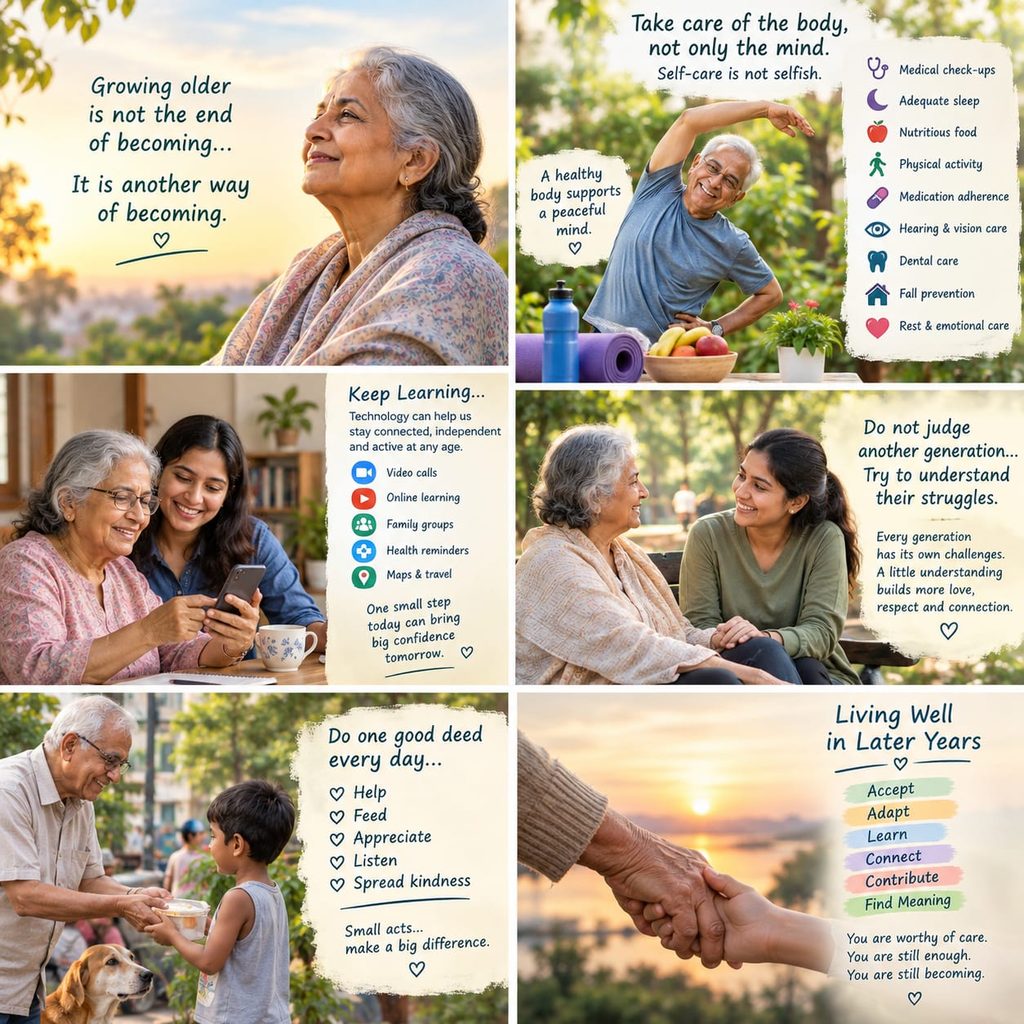
Self-care in later life may include:
Regular medical check-ups.
Adequate sleep.
Nutritious food.
Appropriate physical activity.
Medication adherence.
Hearing and vision care.
Dental care.
Fall prevention.
Maintaining a safe and comfortable home environment.
Taking enough rest when the body needs it.
You mention walking and gentle movement, but physical wellbeing deserves a clearer place because the body and mind are closely connected.
Self-care is not selfish.
A senior person may have spent most of life caring for others. It is okay to now take care of oneself as well.
It is also okay to receive care.
You cared for others; it is okay to let others care for you.
Sometimes asking for help is not dependence—it is wise self-care.
5. Think Positively – Building a Hopeful Mindset
Psychological purpose: Optimism
The fifth point, “Think positively,” is a core idea in positive psychology and self-help. Writers like Norman Vincent Peale (The Power of Positive Thinking) and many modern researchers highlight that an optimistic, hopeful mindset helps people cope better with stress, illness, and change, including in later life.
Positive thinking does not mean ignoring problems. It means:
Focusing on what is still possible, not only on what is lost.
Looking for small opportunities for joy, connection, and contribution every day.
Training the mind to notice good moments, however small.
A senior person can practice this by:
Starting the day with 2–3 short affirmations, such as:
“I am useful.”
“I can learn something new today.”
“My life still has meaning.”
Ending the day by recalling three good things: a phone call from a child, a tasty meal, a pleasant walk, a kind word from a neighbor.
Choosing hopeful language: instead of “I am just sitting at home,” say “I am resting and observing life; I am available for my family.”
Over time, this habit changes the emotional tone of daily life.
6. Solve Problems and Keep Learning – Especially With Technology
Psychological purpose: Autonomy and cognitive engagement
A very practical point for today’s world is: try to solve problems instead of only repeating them, and keep learning new things—even in old age.
Many seniors feel scared of new technology: smartphones, video calls, online payments, health apps, YouTube, and so on. They hear about scams and think, “It’s better not to touch anything.”
But technology is not only for time-pass or reels; it can be a powerful tool for learning, connection, safety, and independence in later years.
It is not necessary to learn everything at once. The key is:
Start with one useful thing, not ten.
Use it regularly until it feels easy.
Then, if you wish, add one more skill.
For example, a senior might choose:
Learning to make video calls to children and grandchildren who live in another city or abroad.
Using YouTube to follow gentle exercise videos, bhajans, cooking recipes, or talks by spiritual teachers.
Using WhatsApp to stay in a family group, share photos, and receive updates.
Using online maps to check routes before going to a new place, or to show a driver the exact location.
Using health apps or reminders to track medicines, appointments, and basic health numbers.
Yes, there are scams, and it is wise to be careful. But fear should not stop all learning.
Seniors can:
Ask a trusted child, grandchild, or friend to help set up the phone safely.
Learn a few simple rules: do not share OTPs or passwords; do not click unknown links; confirm any money request by calling the person directly.
Start with “safe” uses first: calls, messages, videos, music, prayers, recipes, light learning.
When an older person learns even one new digital skill, something important happens: confidence grows.
The inner story changes from:
“I am too old for this”
to:
“I can still learn.”
Technology, used simply and safely, can:
Reduce loneliness through regular video calls and family groups.
Support health through reminders, information, and tele-consultations.
Keep the mind active through courses, talks, and new hobbies.
Increase independence by helping with travel, shopping, banking, and information.
So the message is clear: do not be paralyzed by fear of scams; be wise, be careful, but keep learning.
Choose one useful thing, practice it, and let it become a small source of strength in daily life.
Do Not Judge Another Generation – Try to Understand Their Struggles
One important part of peaceful ageing is understanding that every generation has its own struggles.
Older people may sometimes feel that younger generations have changed too much. They may feel that young people spend too much time on phones, do not communicate like earlier generations, or do not understand the value of certain relationships.
But younger generations also live with pressures that may not always be visible to older people—academic competition, career uncertainty, financial pressure, social media, changing relationships, and the constant pressure to keep up with a rapidly changing world.
Similarly, younger people may not always understand the loneliness, physical changes, loss, or emotional difficulties that can come with ageing.
Therefore, instead of quickly judging another generation, it may help to ask:
“What struggle might they be facing that I do not understand?”
Understanding does not mean agreeing with everything.
It means giving each generation the space to be understood.
Give Space to Grief and Loss
Growing older can bring different kinds of loss—loss of loved ones, health, mobility, familiar roles, friendships, independence, or the life one once knew.
These losses deserve space.
Positive thinking does not mean that a person should never cry or feel sad.
Sometimes it is okay to cry.
Sometimes it is okay to talk.
Sometimes it is okay to sit quietly and remember someone.
Grief is not weakness.
A person may need family support, friendship, spiritual support, or professional help while adjusting to a major loss.
The goal is not to forget the person or the past.
The goal is to slowly learn how to carry the memory while continuing to live.
Do One Good Deed Every Day – Helping, Feeding, Appreciating, and More
A final and deeply meaningful practice is: do one good deed every day.
In later years, when physical energy may be less and roles at work or home may change, small acts of kindness become a powerful way to feel useful, connected, and at peace.
A “good deed” does not have to be big. It can be as simple as:
Helping someone: guiding a neighbor, sharing information, accompanying someone to the clinic, or helping a grandchild with homework.
Feeding or caring: offering food to a domestic helper, security guard, or street animal; sharing extra rotis or fruit; watering plants on the balcony or in the building.
Appreciating others: sincerely thanking the maid, driver, watchman, or shopkeeper; praising a family member’s effort; sending a voice note of encouragement to a friend.
Listening: giving full attention to a child, spouse, or friend who wants to talk; letting them feel heard and valued.
Praying or sending good wishes: quietly wishing well for family, friends, and even people one has had differences with.
Doing one good deed daily brings several benefits for seniors:
It shifts focus from “What is wrong with me?” to “What good can I do today?”
It creates small but real connections with others, reducing loneliness.
It builds a sense of purpose: “My life still matters; I can make someone’s day a little better.”
It supports positive thinking and reduces negative self-talk, because actions of kindness generate inner warmth and satisfaction.
But contribution does not mean that seniors must always give.
Sometimes receiving is also part of a meaningful relationship.
It is okay to help others, and it is also okay to let someone help you.
It is okay to give love, and it is okay to ask for love.
It is okay to care for others, and it is okay to say:
“Today, I need someone to care for me.”
A simple rule for seniors can be:
“Before I sleep, I will remember one good thing I did for someone today—and one good thing I did for myself.”
Over weeks and months, this can become a strong foundation for a peaceful and meaningful life.
Living Well in Later Years
The purpose of healthy ageing is not to remain young forever. It is to live the present stage of life with acceptance, dignity, curiosity, connection, and purpose.
Accept what cannot be changed.
Adapt to what life brings.
Learn something new.
Connect with people.
Contribute in whatever way is possible.
Find Meaning in everyday life.
And perhaps most importantly:
A senior person does not have to prove their worth by always being strong, independent, or useful.
They are worthy of care even when they need help.
They are worthy of respect even when they cannot contribute as before.
They are allowed to ask.
They are allowed to receive.
They are allowed to grieve.
They are allowed to learn.
They are allowed to want something for themselves.
And they are still allowed to create joy and meaning in their own way.
Growing older may change the way we live, but it does not take away our right to live meaningfully.
Dr. Shakuntala Sinha holds a Ph.D. and an M.A. in Applied Psychology, along with a B.Sc. degree and a Diploma in Educational and Vocational Guidance and Counselling (EVGC). She served as a School Counsellor with the Government of Delhi and retired from service in 2007. Her professional journey reflects a longstanding commitment to psychological well-being and human relationships. Even after retirement, she continues to share her knowledge and experience through marriage and relationship counselling, helping individuals and couples navigate personal challenges, strengthen relationships, and develop healthier ways of understanding one another.