

How emotional distress can manifest as physical illness
By : Dr. Vibha Saran
During my internship at Sanjay Gandhi Postgraduate Institute of Medical Sciences (SGPGIMS), Lucknow, I encountered a case that profoundly shaped my understanding of the intricate relationship between the mind and the body.
A 10th-grade student was brought to the hospital repeatedly with severe stomach pain and other gastrointestinal complaints. His father was deeply worried, as the symptoms were intense, recurring, and affecting the boy’s daily life. The child underwent numerous medical investigations, attended frequent follow-up visits, and received different medications. Yet every test came back normal, and nothing seemed to relieve his suffering.
As I observed the case, I began to wonder whether the symptoms might have a psychological component. I shared my thoughts with my senior consultant, suggesting that emotional stress could be contributing to the child’s condition.
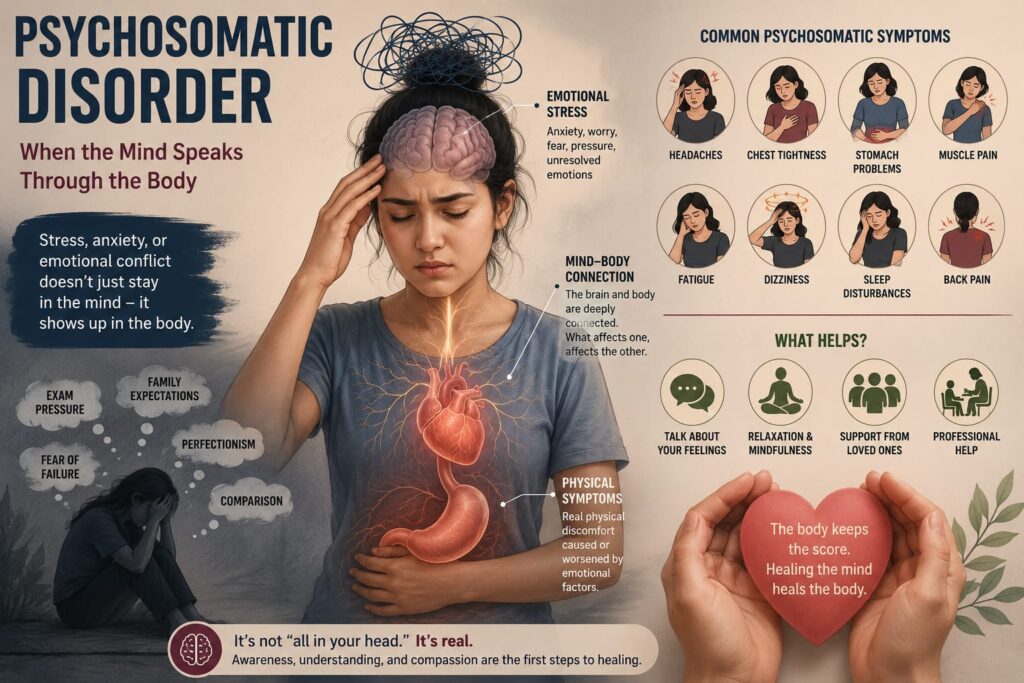
The consultant spoke separately with the boy and his father. During those conversations, an important truth emerged. The child was under immense stress because of his upcoming board examinations. The fear of failure, academic pressure, and unspoken anxiety had become overwhelming. Unable to express these emotions openly, his mind had begun communicating through his body.
The family was counselled about stress and its effects on physical health. They were reassured that the symptoms were genuine—not imaginary—but were closely linked to emotional distress. As the boy received psychological support and his anxiety gradually reduced, his physical symptoms also improved.
This experience taught me a lesson that has remained with me throughout my professional journey: not every pain has a purely physical cause. Sometimes, the body speaks the language of emotions when the mind cannot find the words.

Many people experience persistent headaches, chest tightness, stomach discomfort, dizziness, fatigue, or muscle pain, only to be told that all their medical reports are normal. Such situations can be confusing and frustrating, both for patients and their families. However, normal investigations do not necessarily mean that the suffering is unreal.
This is the reality of psychosomatic disorders—conditions in which emotional or psychological distress manifests as genuine physical symptoms. These symptoms are real, often distressing, and capable of significantly affecting a person’s quality of life, even when no underlying structural disease is detected through routine investigations.
Modern medicine increasingly recognises that the mind and body function as one integrated system. Our emotions influence the nervous, endocrine, and immune systems. When stress becomes chronic or emotions remain suppressed, the body’s stress response remains continuously activated. Over time, this may result in physical symptoms despite the absence of any identifiable disease.
Psychosomatic symptoms can affect almost every organ system. Individuals may experience nausea, bloating, abdominal pain, indigestion, or worsening of Irritable Bowel Syndrome (IBS). Others develop chest tightness, palpitations, or rapid heartbeat. Some experience muscle pain, stiffness, joint aches, headaches, dizziness, tingling sensations, persistent fatigue, or unexplained weakness.
One of the greatest challenges in diagnosing psychosomatic disorders is that many symptoms are subjective. Pain, nausea, fatigue, and dizziness cannot always be measured through laboratory tests or imaging studies. Consequently, patients often undergo repeated investigations that return normal results. This frequently leads to frustration, repeated hospital visits, and unnecessary healthcare expenses.
Unfortunately, these individuals are sometimes told that “nothing is wrong” or are made to feel that their symptoms are exaggerated. Such misconceptions only increase emotional distress. It is important to understand that psychosomatic symptoms are not imaginary, fabricated, or intentional. They are genuine physical experiences arising from complex interactions between psychological and biological processes.
Psychosomatic disorders rarely result from a single cause. They usually develop through an interaction of psychological, biological, and social factors. Chronic stress, unresolved emotional conflicts, traumatic experiences, academic or occupational pressure, family difficulties, anxiety, depression, and post-traumatic stress disorder (PTSD) are among the common contributors. These factors repeatedly activate the body’s stress response, eventually affecting physical health.
Diagnosis requires a careful and balanced approach. Medical professionals must first rule out serious physical illnesses. Once this has been done, equal attention should be given to psychological and social factors that may be contributing to the symptoms. A comprehensive biopsychosocial assessment enables clinicians to provide an accurate diagnosis and appropriate treatment.
The encouraging news is that psychosomatic disorders are highly treatable. Effective management requires collaboration between physicians, psychologists, psychiatrists, physiotherapists, and other healthcare professionals. Psychological interventions, particularly Cognitive Behaviour Therapy (CBT), help individuals identify unhelpful thought patterns, manage stress, and develop healthier coping strategies. Mindfulness, meditation, yoga, breathing exercises, relaxation techniques, and regular physical activity further help regulate the body’s stress response. When necessary, medications may also be prescribed to manage associated anxiety or depression under medical supervision.
Lifestyle modifications play an equally important role. Adequate sleep, balanced nutrition, regular exercise, effective stress management, and strong social support all contribute significantly to recovery.
If you or someone you know continues to experience persistent physical symptoms despite normal medical reports, do not lose hope or dismiss the symptoms. Consult both a physician and a qualified mental health professional. Seeking psychological support does not mean the illness is “all in the mind.” Rather, it reflects an understanding that the mind and body are inseparable, and that both deserve equal attention in the healing process.
The young boy I met during my internship recovered not because another investigation discovered a hidden disease, but because someone listened beyond his symptoms and recognised the silent burden he was carrying. His story serves as a powerful reminder that medicine is not only about treating organs—it is about understanding people.
As healthcare professionals and as a society, we must remember that true healing begins when we listen not only to what the body is saying but also to what the mind has been trying to express. Sometimes, the most important diagnosis is not found in a laboratory report, but in a compassionate conversation.

About the Author
Dr. Vibha Saran is an Associate Professor at Apex College of Nursing and Apex Paramedical Institute, Varanasi. She is the Founder and Executive Member of the Academic Society for Physiotherapy (ASPT). With an interdisciplinary background in physiotherapy and psychology, she is actively involved in teaching, research, and academic writing. She is the author of Mindscape: A Comprehensive Textbook of Psychology and has multiple published utility patents. Her areas of interest include mental health, psychosomatic disorders, psychological assessment, and the integration of psychology into healthcare education.